
Floyd County Civil Docket Searches
Start with MyCase. Pick Case or Name, choose Floyd County, and select CV where it fits. Family and probate sit in their own categories, even if they sound civil in everyday speech. A case number works best as a search key, but with a name you can compare court, type, file date, status, and style before opening the summary.
- Select Floyd County, not the statewide default.
- Enter a case number or a carefully limited name.
- Use CV, FAM, or PR only when the case class is known.
- Read the header and related-case fields.
- Ask the Clerk for an absent document or official copy.
The county FAQ confirms that case number, party, and attorney are all searchable. The Clerk helps in person too. Visit room 235 at 311 Hauss Square, call 812-948-5411, or send a specific records request.
Floyd's $2,500 Assignment Line
Floyd County splits civil CC cases with a money line. Under the local assignment plan, claims at or above $2,500 go to Superior 3 and claims below $2,500 go to Superior 2. That line is a county assignment rule, not a statewide jurisdiction definition. Related cases and representation can shift things, so the court field in MyCase controls.
Small claims and residential eviction land in Superior 2 as well. Commercial and eligible-commercial tracks usually go to Superior 3.
Civil Dockets: What They Show
A Floyd County civil docket entry shows the case number, court, type, status, file date, style, and parties with their roles. The public record also lists attorney information, events, hearings, fees, transactions, cross-references, related matters, and any event documents available online.
| Case header | Court, number, type, status, style, and file date |
|---|---|
| Parties | Public roles and attorney appearances |
| Events | Claims, service, answers, motions, hearings, and orders |
| Related records | Cross-references or companion matters |
| Financial area | Fees and transactions that require Clerk confirmation |
Read filing, service, answer, hearing, judgment, and post-judgment entries in order. Even when the Clerk holds a filing, the document icon may not appear next to it.
A Floyd Claim Is Not Judgment
A complaint or small-claims filing is only a claim. It records what a party alleges and wants, and it is not a ruling. Follow the Floyd County civil docket through service, responses, settings, and the final judgment or dismissal entry. The dollar amount in a claim deserves the same caution, since it does not establish what the court ordered.
Myth: A filed claim proves the result.
Fact: Only later judgment, dismissal, or settlement-related entries show how the matter ended, and the underlying order may require a Clerk request.
What Cases Fill the Civil Docket
The CV category in Floyd County spans ordinary civil, tort, contract, property, small-claims, eviction, and commercial work. Probate, estates, trusts, adoption, and guardianship usually point toward Circuit and the PR or family category instead. Labels a searcher would choose do not control assignment. The local plan and related-case rules do.
| Matter | Local starting clue |
|---|---|
| Small claim or residential eviction | Superior 2 |
| Commercial or eligible commercial | Superior 3 |
| Estate, trust, guardianship, adoption | Circuit |
| Other civil track | Read the MyCase court header |
These are routing clues, not a substitute for the filed record.
Floyd Small Claims Stay in Superior 2
For the division that takes small claims, residential eviction, traffic infractions, and assigned matters, the official Superior Court 2 page is the local source.
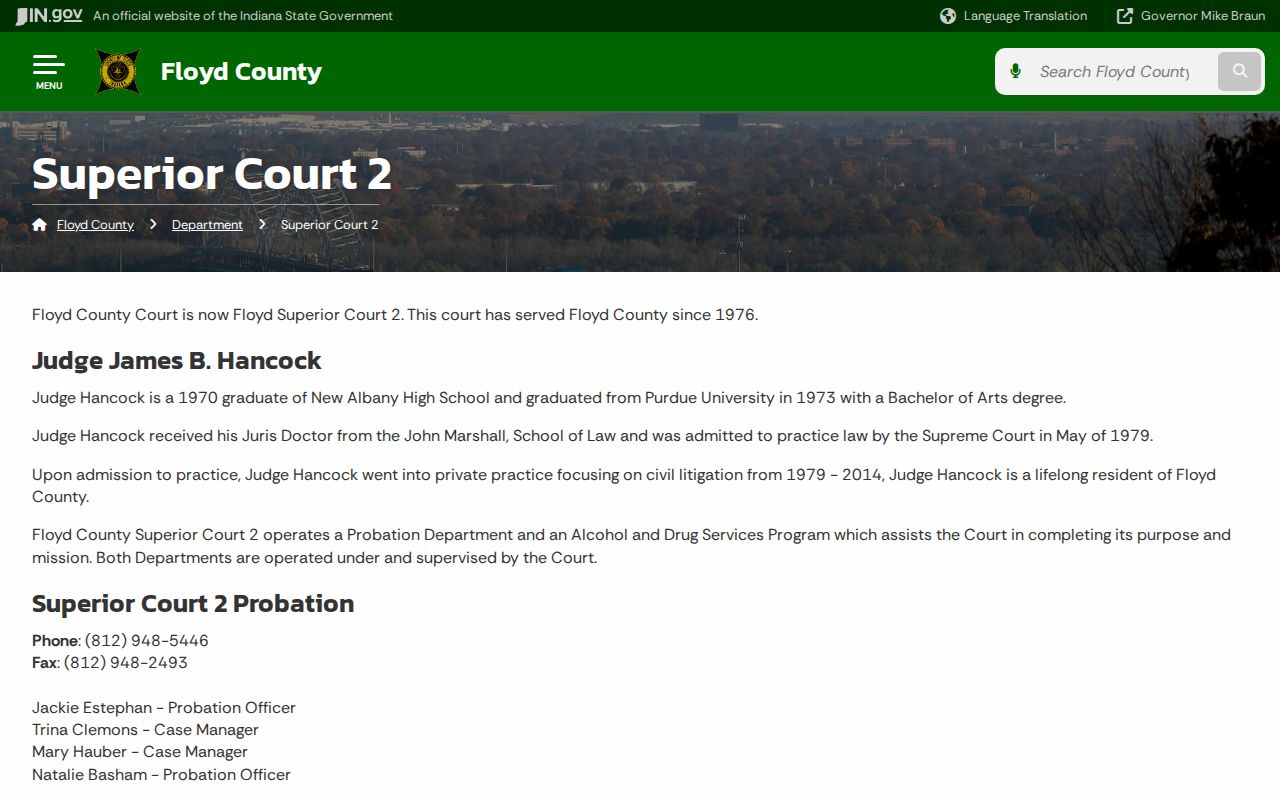
That official page is a good reason to verify the assigned division before calling about a Floyd County civil docket. An online small-claims or eviction order still does not promise remote access to every pleading, exhibit, service return, or payment record. Ask the Clerk whether an item sits online, waits in the records room, or needs retrieval.
Hearings on the Civil Docket
Civil settings show up among the chronological events. Each one lists a court or session name, date, time, judicial officer, result, and cancellation information when exposed. A short event description may not reveal the deadlines set in a scheduling order. Continued or canceled events stay in the sequence and still matter to the reading. Go by the newest setting, and confirm any unclear date with the assigned court. The Floyd County court schedule page lays out the online and phone routes. A pending request to continue does not move a hearing by itself.
Indiana E-Filing Is Not MyCase
Indiana's e-filing system handles submission and service of filings. It is not the public docket search. Members of the public use MyCase, while parties and lawyers may have authenticated services with different access. E-filing changed how a document travels into a Floyd County case, yet not every document became remotely public.
The state page helps separate filing a record from searching the public event history.
Who Can See Civil Dockets
Indiana Administrative Rule 4 generally opens court records, while Rule 5 shields confidential case classes and personal information. A public civil case can still hold a confidential filing or redacted fields. Juvenile, mental-health, adoption, protection-order, and granted-expungement records carry extra limits.
Indiana Code 5-14-3-3 supports inspection and copying with reasonable particularity, subject to exemptions and court-record rules. Indiana Code 5-14-3-5.5 provides a sealing process. A blank document link alone does not prove a file is sealed.
Missing document: Give the Clerk the Floyd court, case number, event, date, format, and whether a plain or certified copy is needed.
Floyd Civil Fees Need Context
The Clerk fee schedule lists sample amounts: $177 for divorce, $232 for civil plenary or tort, $157 plus $10 per additional defendant for a generic case filing, $196 for paternity, $177 for estate, guardianship, or trust work, and $97 plus a $28 sheriff fee and $10 per additional defendant for small claims.
Treat those as filing examples. They are not a balance calculator for an existing case, where type, service, added defendants, and later orders all matter. Confirm current charges and transaction questions with the Clerk, since MyCase financial information can be incomplete.
Requesting a Floyd Civil Document
When an event shows no document link, write down the court, the case number, the event description, and the date. Do that before you go further. Check that category against Indiana's public-access table. Then ask the Clerk a pointed question. Is the item restricted from remote view, sitting in the records room, or sold as a plain or certified copy? A narrow request works far better than asking for everything filed under a name.
Placing an online order does not guarantee you will receive every pleading, exhibit, service return, or transaction record. Transcripts travel a separate route through the court reporter. Say which format you need. The Clerk must match each item to the correct process.
Related Floyd Cases Can Shift Courts
Floyd County's local rules allow a related-case exception, plus one for representation. So a matter that looks like it belongs in Superior 2 or Superior 3 may actually sit somewhere else. That happens because a connected case is already pending. Cross-reference fields are only clues. They do not merge two proceedings into one.
Open each case on its own. Compare the court and the status, then follow that file's own events in order. When an order seems to belong to two matters, ask the Clerk which file actually holds it. That way a judgment or a setting from one Floyd County civil docket is never credited to another.
Floyd Civil Events Form a Sequence
Read a civil CCS as a timeline and it starts making sense. The filing opens the matter. Service entries show attempts or completion, then an answer or another response may follow. Motions can lead to hearings or orders. After a judgment, the docket may add collection, payment, satisfaction, appeal-related, or enforcement entries. Not every case hits every step, and a settlement can produce a different sequence entirely. The event description tells you more than the status label alone. So does any attached order, when public.
Be careful with service in small-claims and eviction files. A filed claim does not prove anyone was served. A service entry does not establish the final result, either. Read forward to the hearing and the judgment. If a return, exhibit, or order is missing online, ask the Clerk. Ask for that specific item. The state access table separates order availability from other documents in the small-claims and eviction categories.
The same chronology fixes misleading snapshots. A case can stay open after a major ruling, or show closed even though later public documents were entered afterward. Status is just one field in the court record. It is no substitute for reading the events in order.
Floyd Civil Search Fields Narrow Results
MyCase supports a Floyd County civil docket search by case number, party name, business name, or attorney. Set the court control to Floyd County first. Case number is the strongest key. Party-name searches require a last name if you fill in other personal-name fields. A business search uses its own field. Sounds-like matching catches spelling variants but can also widen the results considerably. Before picking a case, compare the style, court, type, file date, and status.
| Field | Use | Reading check |
|---|---|---|
| Court | Select Floyd County | Confirm the specific Circuit or Superior division in the header |
| Category | CV, FAM, or PR when known | A category is an index filter, not a full legal description |
| Status | All, open, or closed | Access to documents does not depend on status alone |
| File dates | Narrow a known period | File date is not a hearing or judgment date |
| Related case | Identify a linked matter | Read each case separately |
A dead-end in a Floyd County civil docket search usually has a simple cause. The category may be wrong. The date window may be too tight. Spelling may be off, or the case falls under a confidential class or an older conversion. Retry with the case number, or strip away a few optional filters. Broadening a common name forever just floods the screen with noise. The Clerk can confirm the number itself. The Clerk can also tell you whether the record is legacy, restricted, or simply not part of the remote view.
Floyd Probate Takes a Different Route
Probate work in Floyd County does not follow the civil track. Estates, trusts, adoptions, and guardianships typically route to Circuit Court. That comes from the county's local assignment information. So in MyCase the PR or family category may be the smarter starting point than CV. Juvenile and adoption files carry real access limits. When a public search comes up empty, ask the Clerk instead of assuming the file does not exist.
The official Floyd Circuit Court page is the place for division contact. MyCase remains the first public index to check for any available summary. Need a certificate, a transcript, or a certified order? Indiana's court-record guidance names the custodian for those. Each channel hands out different records, so treat them as separate stops rather than one counter.
Floyd County's one-court selector is a convenience, but the case header settles routing for good. Once the assigned division shows up, take scheduling questions to that court and copy requests to the Clerk. That split saves time. It also keeps a live calendar, a docket event, and the underlying case file separate. They never blur into one thing.