
Floyd County Court Record Requests
Start with MyCase for a public index, CCS, and displayed documents. For the official file, call the Floyd County Clerk at 812-948-5411 or contact room 235, 311 Hauss Square, New Albany, IN 47150. Mail and counter requests should identify the court, cause number, exact item, and plain or certified status. No standard Clerk web form or fixed turnaround was located.
- Locate the cause number and assigned court in MyCase.
- Ask whether the item is public and needs advance retrieval.
- Submit a precise counter or mailed request; use the county APRA route when custody is unclear.
- Confirm page count, copy type, payment, and delivery.
- Request transcripts from the court reporter.
Three Floyd County Court Record Layers
The MyCase index identifies a case, the chronological case summary lists dated events, and the official file holds the papers. A CCS line can exist without an online image after a legacy Odyssey conversion.
- Index
- The searchable case header.
- CCS
- Indiana's event register.
- Case file
- Documents held by the Clerk and court.
The official access table shows how remote access varies.
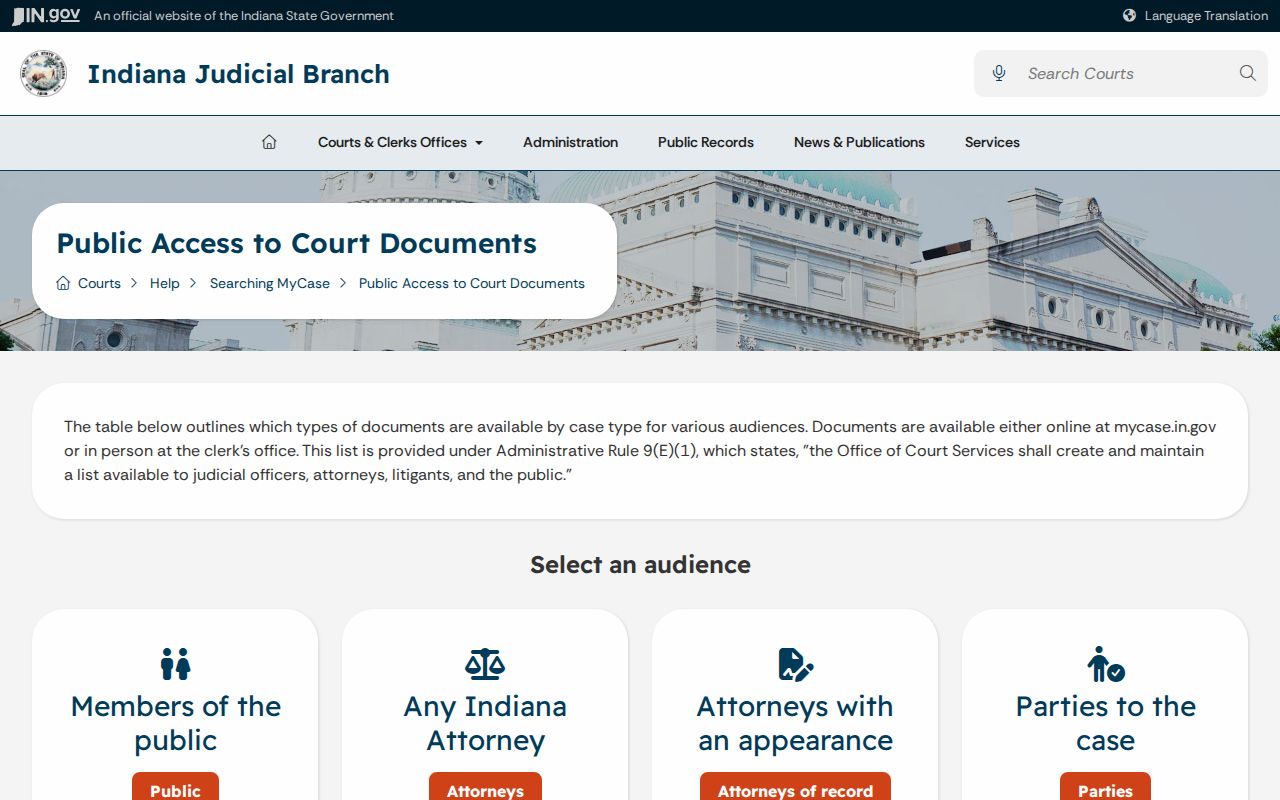
The Clerk remains the source for a certified or missing item.
A MyCase result header can show the court, case type, status, status date, file date, style, and appear-by date. The CCS beneath it can add parties and roles, attorneys, events, hearing fields, fees, transactions, cross-references, and related matters. Those fields help a requester specify what is needed. They do not prove that each underlying filing is open to remote inspection. Asking for the event by date and description is more precise than asking the Clerk to send an entire case without identifying the desired record.
Kinds of Floyd County Court Records
The unified Clerk handles Floyd Circuit and Superior Court files. Public availability depends on the category and document.
- Public criminal, civil, family, probate, and citation summaries.
- Pleadings, motions, notices, orders, and judgments where access permits.
- Fees, transactions, cross-references, and related-case data.
- Probate, estate, trust, guardianship, and juvenile files with special limits.
- Protection-order records through the separate registry and Clerk.
The court assignment helps identify the custodian's working file. Circuit handles the local probate, estate, trust, adoption, guardianship, and juvenile assignments described in the official material. Superior 2 is the usual small-claims, residential-eviction, and traffic assignment point. Superior 3 receives protection-order, commercial, and selected problem-solving work. These routing clues help a requester describe the right Floyd County court record, but the case header remains controlling when an exception or related case changes the assignment.
The Floyd County Court Records Desk
The Clerk routes criminal, civil, small-claims, traffic, family, probate, and records work. Name the court shown in the case header when calling because one unified office serves the Circuit and Superior courts.
The current Clerk contact roles appear here.
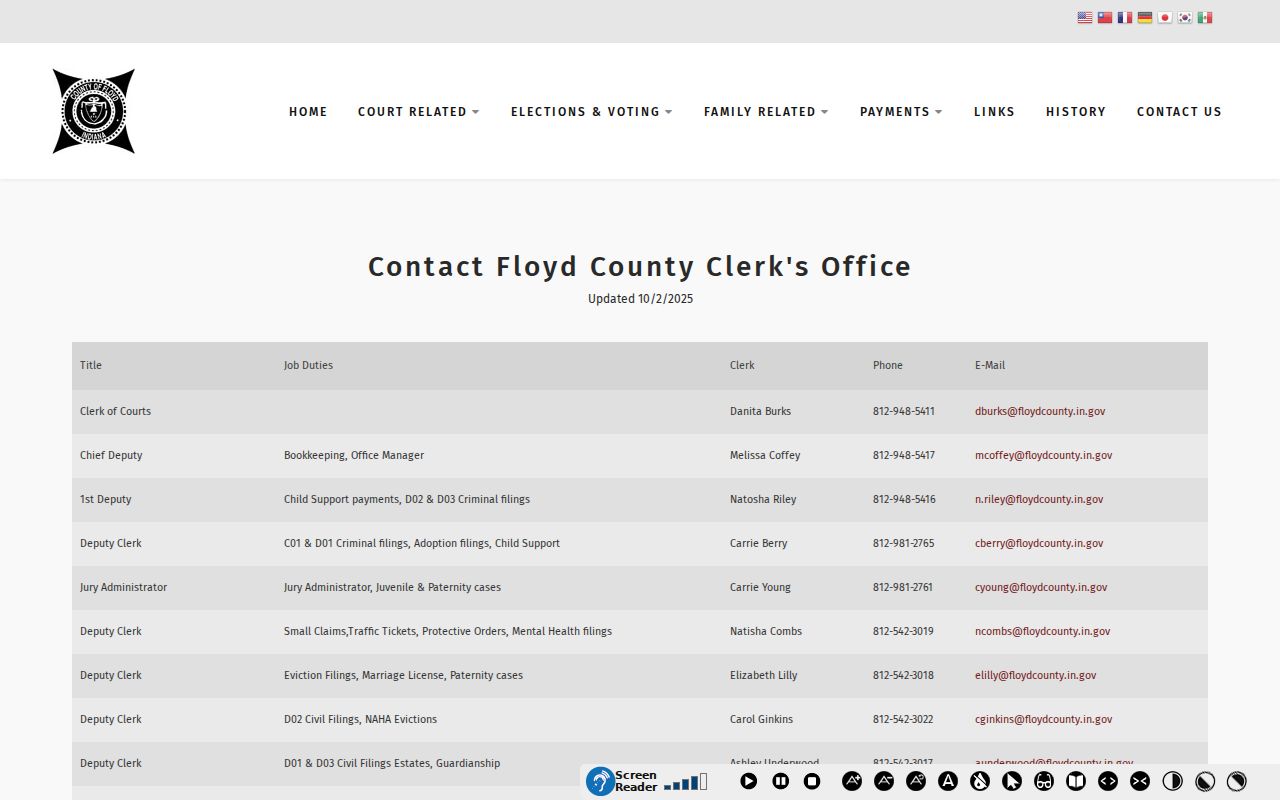
Room 115 is documented for the Recorder, not as a universal court-record room, so confirm custody before visiting.
The physical-access details also need confirmation before a trip. The county Clerk page lists weekday hours from 8:00 a.m. through 4:00 p.m. The Clerk homepage breaks that schedule into 8:00 a.m. to noon and 1:00 to 4:00 p.m., with the office closed for lunch. Room 235 is the Clerk's counter, but stored or restricted material may not be ready for immediate review. Call 812-948-5411 with the court and cause number, ask whether advance retrieval is needed, and confirm both the room and current hours. That step prevents the Recorder's room 115 from being confused with the custodian of a Floyd court file.
Floyd County Court Records: What They Contain
A de-identified Floyd sample showed the broad Odyssey schema below, though document access varied.
| Header | Cause number, court, type, status, file date, and style. |
|---|---|
| Pleadings | Petitions, motions, answers, and notices. |
| Orders | Public rulings, dispositions, and judgments. |
| CCS | Event date, description, judge, and hearing data. |
| Other fields | Fees, transactions, links, and cross-references. |
A hearing event can add the court name, session date and time, result, cancellation status, and judicial officer. Those fields explain the setting but do not create a transcript. Charges and bond data can appear in a criminal case, while claim type, fee summary, and transaction data can appear in civil or small-claims work. Converted events and abbreviated descriptions should be read as index information. When the wording matters, request the underlying Floyd County court record instead of expanding the short CCS label into an unsupported conclusion.
A Particular Floyd County Records Request
The county public-records channel is a fallback when custody is unclear. The Clerk is first for a court case. State the court, cause number, CCS date or document name, and desired copy type.
The county request landing page is shown here.
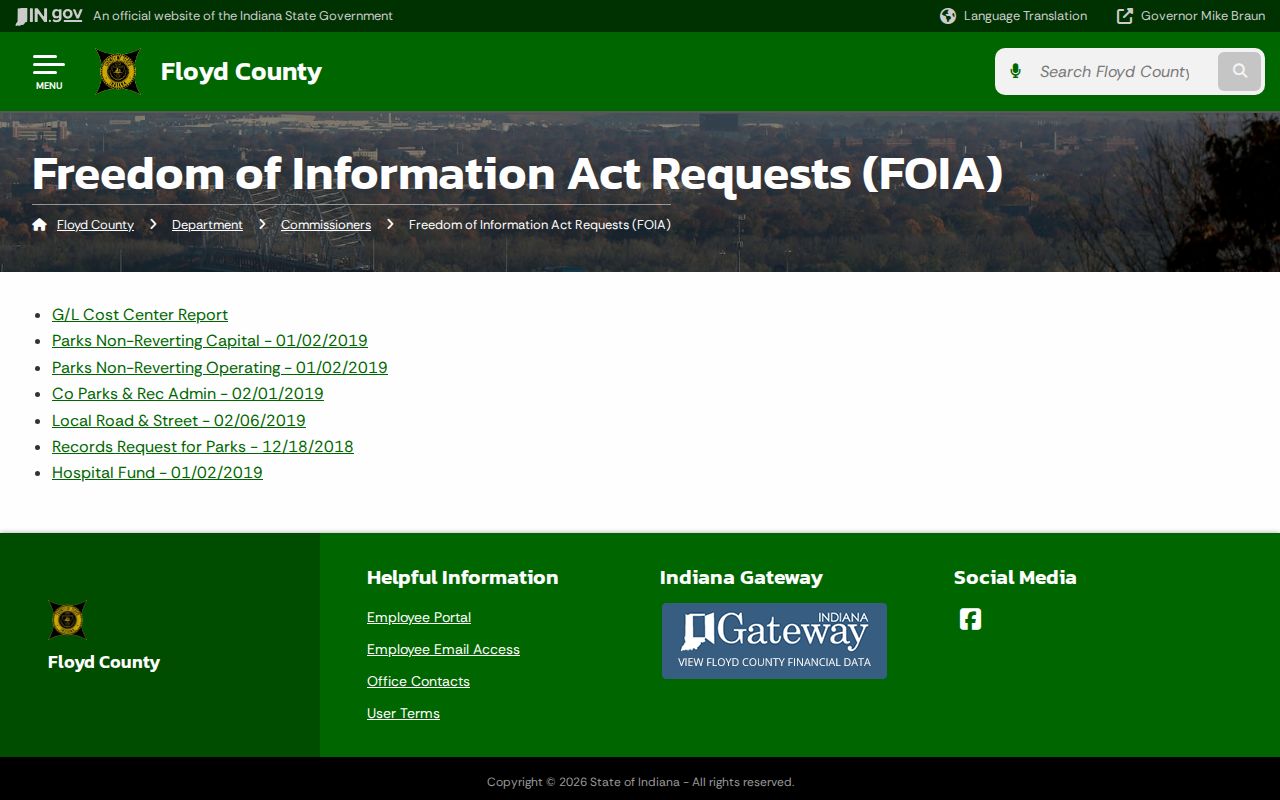
FCO-2023-36 also asks for contact details, date, a clear description, preferred format, and a commercial-purpose statement when a list of individuals is sought. An appointment may be needed for inspection.
A reasonably particular request describes the record instead of asking the county to research a legal question. Supply the Floyd court, cause number if known, party or case style only as needed to locate it, document title, approximate filing or event date, and preferred format. State whether the copy must be certified. The county policy asks for a commercial-purpose statement when the request seeks a list of individuals, but that general policy is not a substitute for the Clerk's case-file process. The direct Clerk route should lead whenever the desired item is a pleading, order, judgment, CCS, or certification from a Floyd Circuit or Superior Court case.
Floyd County Copy Fees and Certification
A plain copy reproduces the item. Certification adds the Clerk's authentication. The August 1, 2024 schedule lists:
| Item | Amount |
|---|---|
| Copy, including a partial page | $1 per page |
| Certification | $3 per document |
| Search fee | Not located |
| Exemplification fee | Not located |
The county department page and the Clerk homepage conflict on accepted payment methods. Both list cash, money orders, and cashier's checks, while only the Clerk homepage also lists major credit and debit cards. That conflict should be resolved by calling before a visit or mailed order. The published charges do not establish that every request is ready at once. An older Floyd County court record may need retrieval, and a confidential item may require a court order rather than payment of a copy fee.
Published Floyd County Copy Charges
The fee page separates copying from certification and does not publish a general search or exemplification charge. County and Clerk pages also conflict on whether major cards are accepted, so call before mailing payment or visiting.
The captured official schedule shows the copy rows.
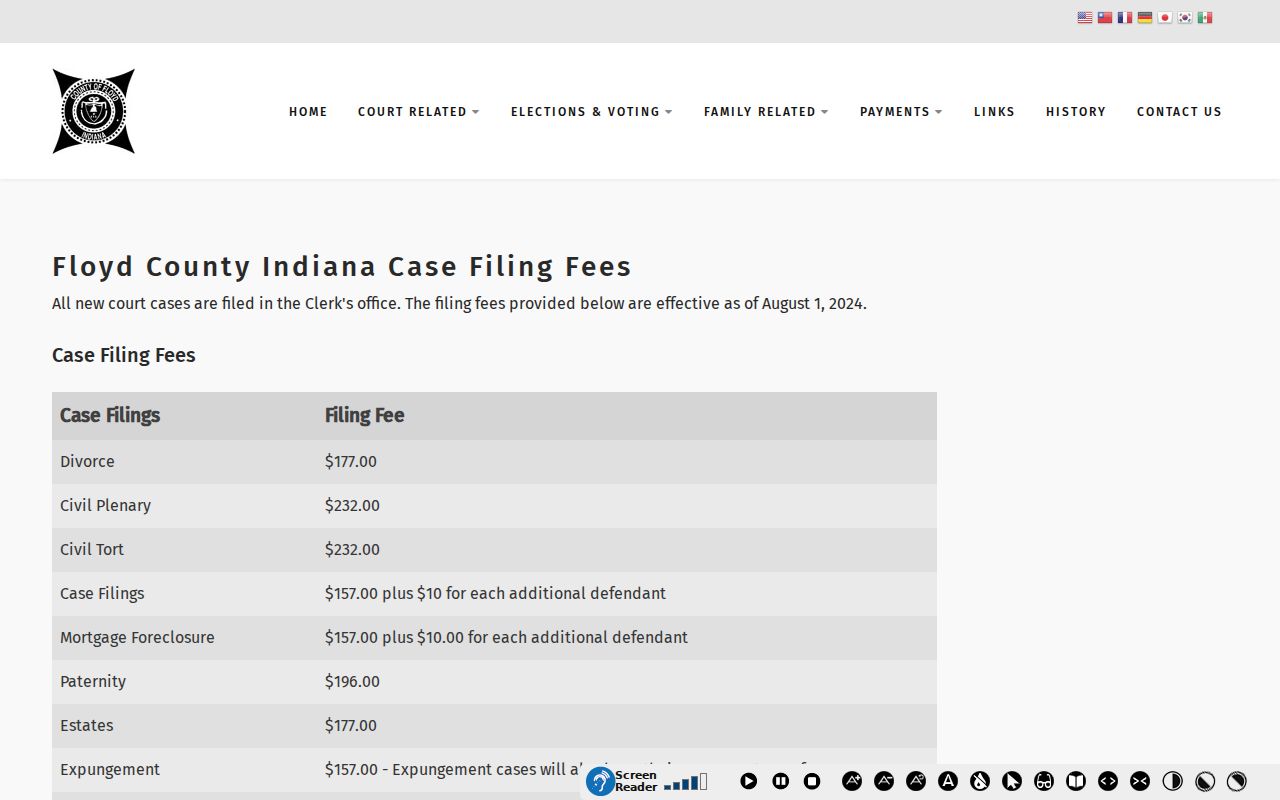
No published turnaround or universal identity rule was found. Ask about retrieval time, page count, payment, and delivery for the specific file.
Certification applies per document, while copying is charged per page; confirm the complete estimate with the Floyd County Clerk before ordering.
A requester should also distinguish a copy from an exemplification or apostille service. The Floyd schedule reviewed did not publish separate charges for those services, so the absence of a row must not be described as a free service. Explain the intended use to the Clerk, ask which form of authentication is available, and obtain the current price before sending funds. That approach also prevents a plain MyCase printout from being mistaken for an official certified Floyd County court record.
When a Floyd County Document Is Missing
An absent image can reflect Rule 5, an older conversion, or a paper held outside MyCase. Give the Clerk the event date and description. Request a transcript from the court reporter. Indiana e-filing is a filing and service system, not the public viewer.
Indiana's official request guidance explains those routes.
MyCase does not cover every court, year, or document. Online absence is not proof that the item never existed.
Floyd's technology history explains part of that gap. Superior Court 3 went live on Odyssey on January 2, 2009, and the other active Floyd courts adopted it on February 17, 2009. The archived selector also retains the abolished Floyd County Court. Older events may have been converted into the system without a scanned historical document. When research reaches that boundary, the Clerk can address the case file, while a court reporter handles a transcript. Neither a converted CCS line nor a missing image should be expanded into a claim about what the original paper says.
Protection-order records use another access path. Indiana maintains a separate public Protection Order Registry, while MyCase excludes protection-order cases and the registry does not display victim information. The Floyd County Clerk handles the court-file route, but public registry data is not the same as the complete case file. Juvenile, mental-health, adoption, guardianship, and expungement material can have their own Rule 5 limits. A requester should name the category, ask whether a redacted public version exists, and follow the assigned court's process if access requires judicial action.
Floyd County Court Record Access Rules
Indiana Access to Court Records Rule 5 governs excluded and confidential court material. Indiana's Access to Public Records Act, IC 5-14-3, supplies the broader county framework but does not open sealed filings.
Key Rules:
Rule 5 identifies records excluded from public access.
Indiana Code 5-14-3 governs broader public-record access.
A visible header does not override confidentiality, redaction, or sealing.
Protection-order public searching uses Indiana's separate registry, and victim information is not displayed there. Juvenile and mental-health case visibility can be limited even though Floyd assignment rules show that those matters exist in the local courts. A request for excluded material is not made valid by sending it through the general county policy. Ask the Clerk which rule applies, whether a redacted public copy exists, and whether relief must be sought from the court that controls the case.