
Floyd County Criminal Docket Searches
Begin with the free Indiana MyCase search. Pick Case, Name, or Attorney. Choose Floyd County. Then select CR, Criminal & Citation, where it fits. A full case or citation number beats a common name every time. Before opening a result, check that the court, type, status, and file date all line up with the case you want.
- Enter the known number or the least amount of name data needed.
- Select Floyd County instead of All Odyssey Courts.
- Open the result and verify its header.
- Read events through the newest entry.
- Call the Clerk at 812-948-5411 when the record remains missing.
The county FAQ confirms you can search by case number, citation number, party name, or attorney. Prefer paper? Visit the Clerk in Room 235 at 311 Hauss Square. A written records request should state the court, the case, the event, the date range, the format, and whether you want a certified copy.
Floyd Criminal Cases Split Four Ways
MyCase offers one Floyd County option. Four courts sit behind it. Local rules split the serious felony and domestic-violence misdemeanor work between Circuit and Superior 1. Superior 2 takes most traffic matters: infractions, ordinances, motor-vehicle cases, and many traffic misdemeanors. Accepted military or problem-solving cases may shift to Superior 3.
The court in the case header controls which office holds the current calendar.
Criminal Dockets: What They Show
Indiana names this event history a Chronological Case Summary, or CCS. The public view lists the court, case type, status, status date, file date, style, appear-by date, and charges. It also shows party and attorney roles, bonds, hearings, cross-references, fees, transactions, and document indicators.
| Header | Court, type, status, file date, and style |
|---|---|
| Charges | Allegations and later disposition data |
| Events | Filings, orders, hearings, notices, and continuances |
| Hearing | Session date, time, result, officer, and cancellation status |
| Documents | Links or indicators subject to access limits |
A Floyd County criminal docket never equals the whole file. Some events carry no attachment you can view from home.
Floyd Charges Are Not Outcomes
A charge entry is only an allegation. Read forward in the docket for a plea, dismissal, judgment, disposition, or sentencing entry. Words like continued, canceled, commenced, and concluded describe hearing procedure, not the outcome. MyCase itself warns that online data can have omissions. Financial fields may be incomplete.
Read the sequence: Match charges to later events and the final disposition. Ask the Clerk for an unavailable order rather than guessing from an abbreviation.
Criminal Case Stages on the Docket
Most Floyd County entries trace a path from filing through arraignment, pretrial work, plea or trial, disposition, and sentencing. Local Criminal Rules 203 through 207 cover motions, continuances, bond, and trial-calendar procedure. The case order still controls the actual date.
After a reset or transfer, stages can repeat. Check the newest event, then follow the Floyd County court schedule workflow to confirm the next setting.
Floyd Veterans Court Meets Tuesdays
The official Superior Court 3 page lists Veterans Court every Tuesday at 8:30 a.m. Day-to-day problem-solving administration sits there under local rules, and transfer happens after acceptance. One caution applies. The public CCS may show a hearing. Treatment, supervision, probation, or mental-health details may stay restricted.
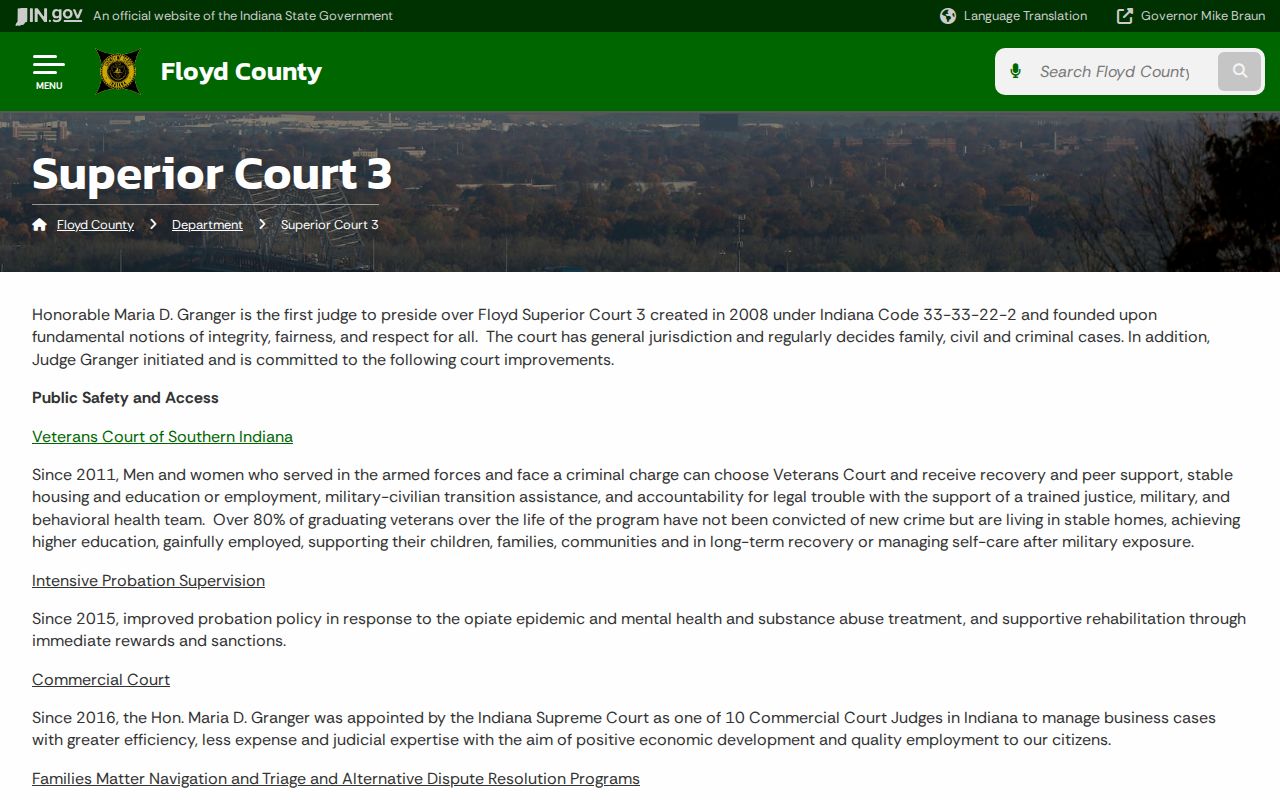
Call Superior 3 at 812-948-5257 to confirm any program setting; do not infer it from limited public text.
Floyd County Criminal Docket Courts
Circuit answers at 812-948-5455, Superior 1 at 812-948-5450, Superior 2 at 812-948-5488, and Superior 3 at 812-948-5257. Always use the court named in the current header. The prosecutor's Criminal Division notes that court staff build the schedules and that dates can shift.
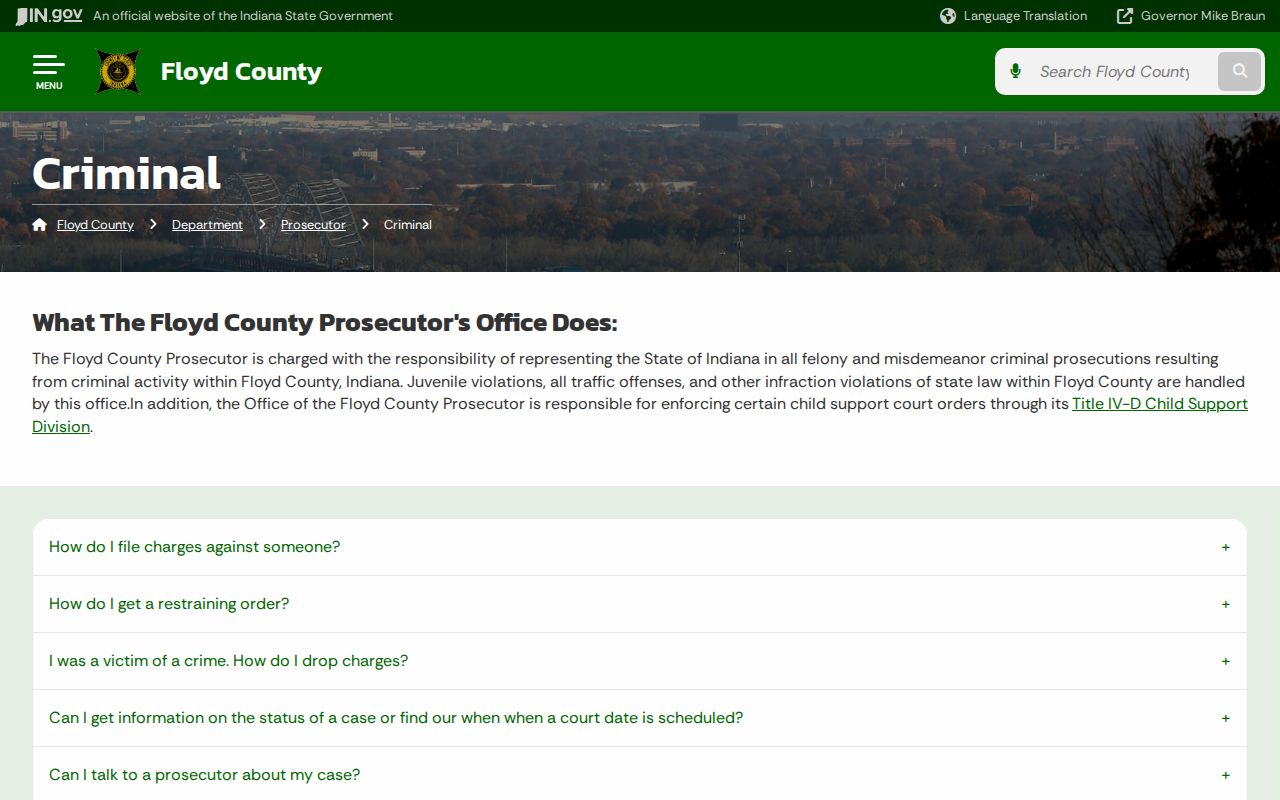
The prosecutor is a case participant; court staff hold the current setting.
Floyd Odyssey Records Date to 2009
Floyd County went digital in stages. The Odyssey court list shows Circuit and Superior 1 and 2 joining in February 2009. Superior 3 joined a month earlier, in January 2009. Older criminal dockets may show converted events or a thin online history.
The Odyssey overview describes how these chronological case summaries work.
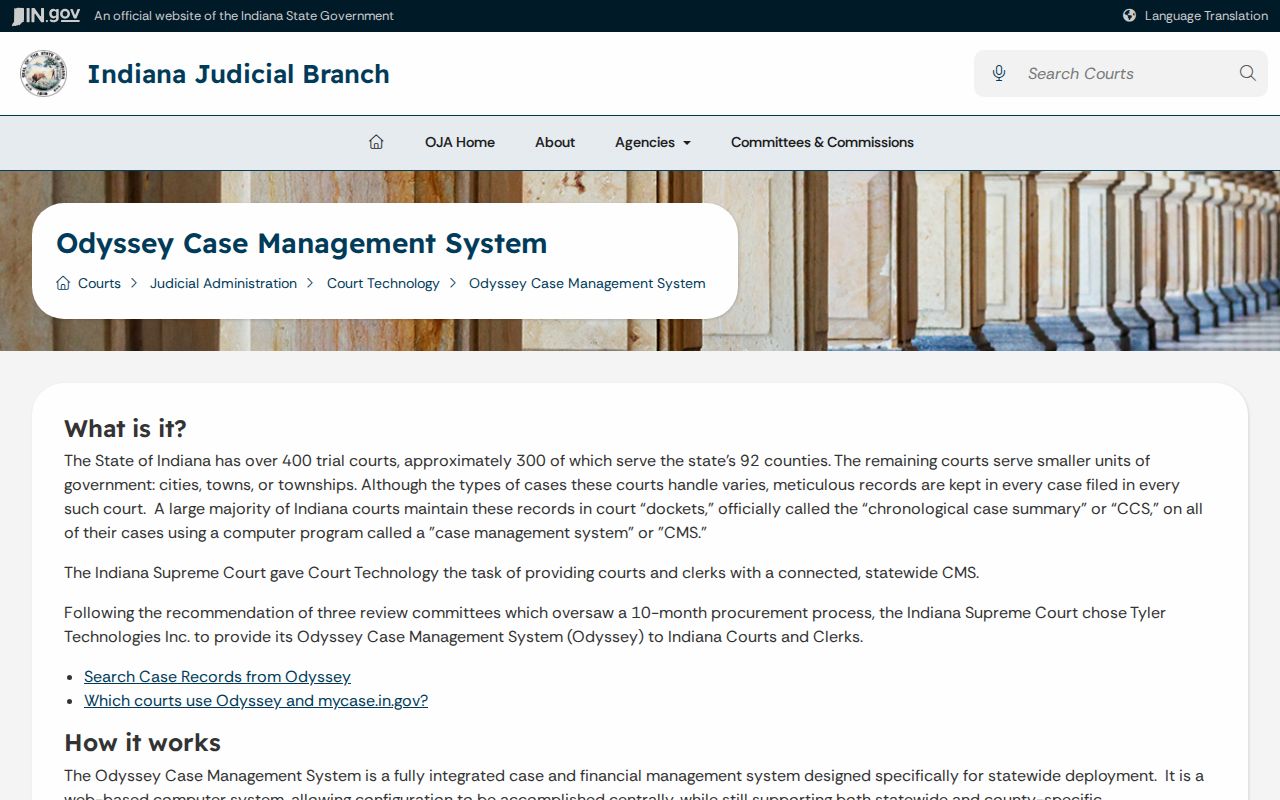
A converted marker means one thing: ask the Clerk about legacy material. It is not proof that no action ever occurred.
Access Rules for Criminal Dockets
Administrative Rule 4 makes access the default. Rule 5 then shields confidential case classes and personal details. Juvenile, mental-health, treatment, probation, problem-solving, expungement, and sealed material can all get special handling. Protection orders live in a separate Protection Order Registry.
Access levels can differ even within one case. The public index, an event's text, and an attached document do not always match. Indiana Code 5-14-3-5.5 allows sealing by court order. A missing result proves nothing about sealing.
Document type matters too for felonies and misdemeanors. The state access table treats sentencing orders differently from other criminal filings. A visible disposition or sentencing event does not mean every related motion, exhibit, or order opens remotely. Redaction can hide protected details while the event itself stays in view. Ask for the specific public document rather than assuming the whole file shares one status.
Indiana Administrative Rule 9 covers remote access, compiled access, and daily calendars. Access to one case never authorizes bulk collection. For ordinary case tracking, rely on the public summary. Get any missing official records from the Floyd County Clerk.
Missing online: Confirm Floyd County and the number, check the state access table, then ask the Clerk whether the item is restricted, legacy, or available only in the file.
Confirm a Stale Floyd Hearing
An old, continued, canceled, or reset CCS entry deserves a second look. Check the newest session date, time, result, and court. An appear-by date is not a hearing. A saved screen can go stale, so call the assigned court. Wanting a continuance does not make one effective. Local Rule 205 requires a written motion plus action by the court.
Reading Floyd Bonds and Transactions
Bond amounts and transaction lines on a Floyd County court docket deserve the same slow reading as the charges above them. Odyssey shows only the summary piece. The conditions attached to a bond, any later change to them, and the signed paperwork can all live in an order that the public view never displays. Pin each bond figure to its event date, then look for any order that came after it. Call the assigned court to ask about current conditions. The Clerk handles copy requests.
Money fields need the same caution. MyCase itself warns that financial information can be incomplete, so treat a displayed amount as a hint rather than a bill. For the real balance, restitution, court costs, or payment history, ask the office that owns the ledger. One summary field is never the final word.
Floyd Search Errors Have Several Causes
A blank results screen in a Floyd County docket search has many possible causes. The court may be wrong, the name misspelled, or the category too narrow. The date window may be unhelpful. The citation may not yet be received, the matter confidential, or the record simply an older one with limited conversion. Try again with the known number and Floyd County selected. Drop the category and date filters before widening a common-name search. Tight criteria beat repeated statewide queries every time.
Protection orders live in a separate Protection Order Registry. For juvenile, mental-health, expungement, or restricted cases, contact the Clerk directly. Do not guess protected facts from a blank screen.
Floyd Criminal Search Fields in Practice
The Case tab on a Floyd County criminal docket search takes a case number, a citation number, or a cross-reference as alternate keys. Official MyCase tips say you can skip hyphens and leading zeroes in a case-number query. A trailing wildcard helps only when it starts with a letter or number. It never works at the front or inside a term. Very broad queries can hit the 1,000-result limit. The Floyd County court filter plus a known filing period keep things manageable.
Names work differently. On the Name tab, a last name is required. That rule applies whenever you supply a first name, middle name, or birth date. The sounds-like option widens spelling matches, but it is only a discovery aid. Two similar names do not prove one person. Before opening a result, check the court, case type, filing date, and public role. The Attorney tab offers a name route or a bar-number route. Use the least personal data you need. Never republish birth dates pulled from a live search.
| Search control | Best use | Floyd County caution |
|---|---|---|
| Case number | Known court identifier | Verify C01, D01, D02, or D03 in the result |
| Citation number | Known ticket-linked record | A new citation may not yet have reached the Clerk |
| Name | Discovery when no number is known | Match court, type, date, and role |
| Attorney or bar number | Find public matters tied to counsel | Do not combine incompatible fields |
| Status and file dates | Narrow a large result set | A closed status does not remove access limits |
If a validation message appears, fix that field. Do not broaden the search over and over. MyCase may also show a captcha after repeated searching. Indiana access rules govern bulk collection and data mining. A focused case lookup is faster anyway. It is also far less likely to hand you a mistaken match.
Floyd Docket Entries Need Source Checks
A style is the short caption of a case. It may be abbreviated or carried over from converted data. A file date marks when the case entered the court system, not when a hearing occurred. A status date tells you when the displayed status changed. Cross-references and related-case fields can explain a transfer or a companion matter. They never merge two histories. Read each Floyd County criminal docket on its own terms.
When a filing is unavailable online, Indiana's court-record request guidance sends you to the county Clerk. Have the assigned court, case number, document or event, and date range ready. Ask whether you need a plain or certified copy. A transcript comes from the court reporter, not MyCase. The order or certified record held by the custodian is what counts as an official result.
The Floyd County Records Department is another copy and retrieval contact listed through the Clerk. It is reachable at 812-542-3011. That channel helps when an older file is thin online. The county's general APRA route remains a fallback for county records. A court-file request should start with the Clerk, who maintains the Circuit and Superior records.